Civoryx vs Sumsub vs Veriff: Which Platform Gives You the Most Actionable Fraud Data?

In the rapidly evolving and highly volatile landscape of 2026, the global battle against digital fraud has definitively fractured into two distinct and equally critical fronts: Active Prevention (the mechanics of stopping fraud at the digital door) and Awareness Data (the intelligence required to understand where the threat is coming from before it even arrives).
For the past decade, the industry’s focus has been almost entirely reactive, relying heavily on industry titans like Sumsub and Veriff to build increasingly sophisticated technical barriers for identity verification (IDV). However, a new player, Civoryx, has emerged to address a massive blind spot in this ecosystem, providing the predictive “weather report” for global fraud trends.
This comprehensive article compares how these three distinct solutions—Sumsub, Veriff, and Civoryx—interact to create a holistic, multi-layered defense strategy. By balancing the real-time, zero-trust verification of standard IDV platforms with the global, macro-trend awareness of statistical intelligence, modern enterprises can finally close the gap between what they know and what they can stop.
The 2026 Landscape and the “Sophistication Shift”
To understand why the integration of awareness data and active prevention is so vital, we must first examine the current state of digital crime. We are no longer operating in an era of high-volume, amateur fraud attempts characterized by poorly photoshopped driver’s licenses and obvious phishing emails. The math of fraud has fundamentally changed.
The Professionalization of Cybercrime
Today, businesses are facing what industry analysts refer to as the “Sophistication Shift.” Fraud is now a highly professionalized, specialized, and well-funded shadow industry. Cybercriminal syndicates operate like modern tech companies, complete with research and development arms, customer service for malware-as-a-service, and specialized teams dedicated entirely to bypassing specific Know Your Customer (KYC) protocols.
The attacks we see today are multi-step, coordinated, and designed specifically to slip through standard binary checks. The gap between what risk professionals think they know (awareness) and what is actually happening at their digital gates (active prevention) is widening.
The Velocity and Scale of Modern Fraud
According to recent 2025–2026 industry reports, the nature of identity crime has moved definitively from content (what the fraudster is saying) to context (how the fraudster is behaving). The statistics illustrating this shift are staggering:
- The Sophistication Spike: Data released by Sumsub reports a massive 180% year-over-year increase in “sophisticated” fraud. These are not simple spoofing attempts; these are attacks that utilize multi-step techniques, synthetic identities, and behavioral manipulation to bypass traditional KYC measures. Furthermore, multi-step attacks as a whole have risen from 10% to 28% of all total fraud attempts globally.
- Impersonation Dominance: Veriff’s internal data reveals an equally troubling trend: impersonation fraud now accounts for over 85% of all fraudulent attempts processed through their systems. Fraudsters are no longer creating completely fake people; they are hijacking real ones.
- The Deepfake Pulse: The evolution of biometric fraud has accelerated beyond the capabilities of older defense mechanisms. Deepfake attempts—where AI is used to generate a synthetic face or voice to bypass liveness checks—were recently clocked at a staggering rate of one every five minutes across global networks.
- Digital Forgery: The days of physical ID counterfeiting are rapidly coming to an end. AI-assisted digital document forgeries have surged by 244%. Fraudsters now use generative AI to manipulate the pixels of digital document submissions, making physical counterfeiting obsolete in favor of digital-first manipulation.
- Profitability of AI Scams: The most alarming statistic for enterprise risk teams is the ROI for the attackers. AI-enabled scams are currently 4.5x more profitable for threat actors than traditional manual fraud, incentivizing further investment into sophisticated attack vectors.
The Economic Reality: The Cost of Missing a Trend
The cost of missing a macro-trend in fraud is almost always higher than the cost of the individual fraudulent transactions themselves. By the time a business reacts to a new scam methodology—perhaps by noticing a spike in chargebacks or unauthorized account access—the financial damage is already baked into the quarter’s financials.
The economic fallout is measurable and severe:
- Total Global Loss: The annual cost of cybercrime was projected to reach an incomprehensible $10.5 Trillion by 2025, a number that continues to climb as we move through 2026.
- The Multiplier Effect: For every $1 directly lost to fraud, the actual cost to the business is $5.75. This accounts for the subsequent costs of investigation, legal compliance, loss of customer trust, regulatory fines, and the operational drag of remediation.
- Targeted Sectors: No industry is immune, but some bear a heavier burden. Crypto scams are estimated to cause $17 Billion in losses annually, while standard e-commerce platforms face fraud rates that are 18x higher than the global baseline average.
The disconnect between threat awareness and active prevention is measurable. While 75% of risk professionals readily acknowledge that fraud is becoming increasingly AI-driven and sophisticated, nearly 37% of firms are still relying on legacy manual processes, isolated checks, or outdated rule engines. They are fighting a 2026 war with 2020 weapons.
Civoryx and the Power of Awareness Data
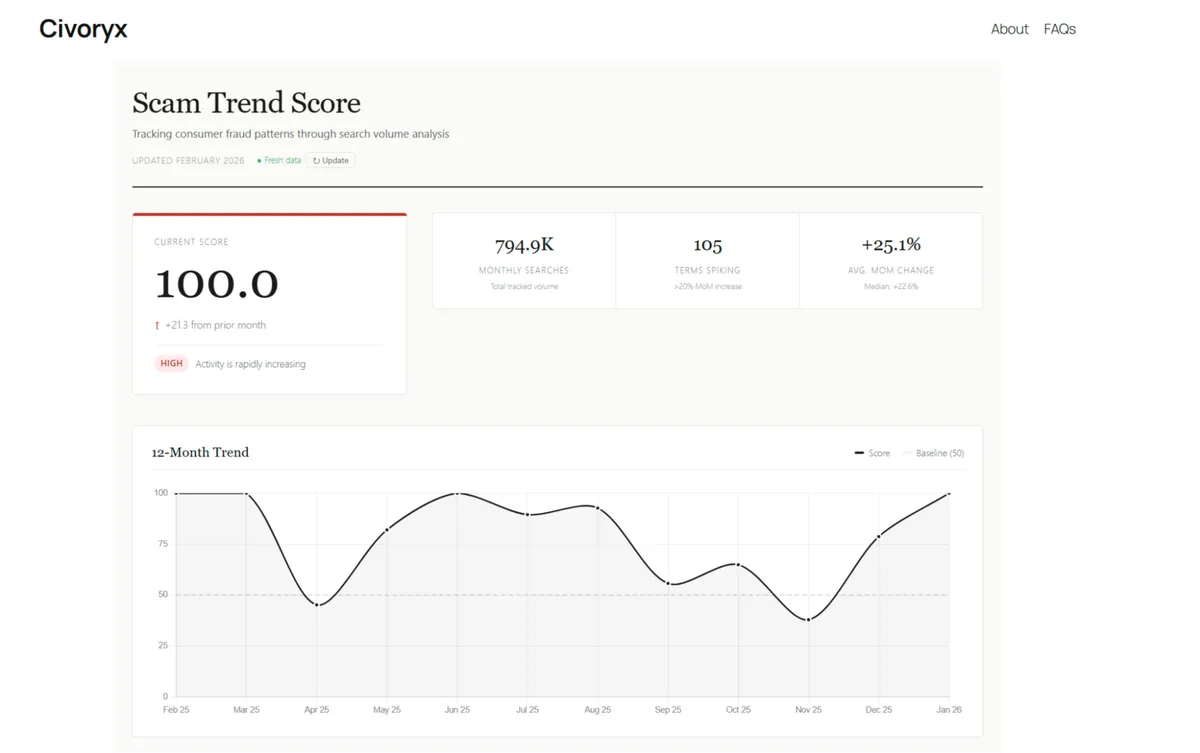
In the standard fraud prevention ecosystem, platforms like Sumsub and Veriff act as the sentries. They stand at the gate, verify the documents, check the biometrics, and block suspicious users in real-time.
Civoryx, by contrast, acts as the global intelligence agency. It does not block individual users, nor does it process ID documents. Instead, it tracks the macro-shifts in fraud behavior across the entire internet, acting as an early-warning system.
The Global Fraud Index
Civoryx is built as a public, free utility designed to solve a very specific and frustrating problem for risk managers: fraud evolves exponentially faster than the news cycle. By the time a specific, named scam—such as “Deepfake Romance Fraud” or “Pig Butchering”—hits the mainstream evening news or is published in a cybersecurity vendor’s quarterly report, the trend has likely already peaked, claiming thousands of victims and millions of dollars in the process.
Civoryx surfaces these behavioral shifts early through its primary metric: The Scam Trend Score.
How the Scam Trend Score Works
The Scam Trend Score is a composite, predictive metric derived from continuously monitoring a highly curated index of over 150 fraud-related search terms and behavioral keywords globally. By tracking the velocity, volume, and acceleration of what the world is actively searching for, Civoryx provides a transparent, data-driven signal of exactly where scam activity is heating up.
Key signals monitored include:
- Phishing methodologies
- Crypto scam terminology
- Romance and affinity fraud tactics
- Deepfake identity theft queries
- Synthetic identity creation tools
The Innovation of TrendWeight™
Raw search data is inherently noisy and often misleading. A massive spike in a keyword like “crypto scam” in a country with a massive population (like India or the United States) might generate huge raw numbers, but it might not represent a statistically significant change in actual threat behavior.
To solve this, Civoryx employs a proprietary weighting system called TrendWeight™. This algorithmic layer automatically adjusts for regional search bias and baseline population metrics. This ensures that a massive volume of searches in a high-population area does not drown out or obscure a statistically significant (and potentially highly dangerous) emerging trend in a smaller region. TrendWeight™ isolates the anomalies, surfacing the true emerging threats regardless of where they geographically originate.
The Value Proposition of Civoryx
Unlike the enterprise, usage-based pricing models of standard IDV providers, Civoryx is fully and permanently free. It requires no account creation, no API gating, and no paywall:
- For Researchers and Analysts: It provides an invaluable historical record of scam velocity, allowing them to map how fast specific fraud typologies move from the dark web to mainstream execution.
- For Enterprise Businesses: It acts as a crucial early-warning system for threat modeling. If the Scam Trend Score for “Synthetic Identity Fraud” spikes in Eastern Europe, a compliance team can proactively tighten the rules in their Sumsub or Veriff dashboards before the wave hits.
- For Consumers: It serves as a public index where individuals can check if a “too good to be true” new investment opportunity is actually a rapidly trending scam.
Statistical Insight shows that businesses actively using awareness data like Civoryx to proactively adjust their risk thresholds report a significant reduction in the “Sophistication Gap.” This predictive intelligence allows them to catch coordinated, multi-step fraud rings that would typically bypass standard, static pattern recognition systems.
Sumsub vs. Veriff – The Sentries of Active Prevention
While Civoryx tells you a storm is coming, Sumsub and Veriff are the entities that physically board up the windows and lock the doors. Both platforms represent the absolute cutting edge of Active Fraud Prevention, offering end-to-end KYC, KYB (Know Your Business), and AML identity solutions with massive global coverage.
While they share the same ultimate goal—keeping bad actors out while letting good customers in—their underlying philosophies and user experiences differ significantly.
Global Coverage and Core Capabilities

Scale is a prerequisite in modern IDV. Businesses operating globally cannot rely on vendors that only understand Western driver’s licenses. So:
- Sumsub’s Unified Ecosystem: Sumsub offers a deeply integrated platform that handles both individual user KYC and complex corporate KYB within a single, unified flow. For KYC, it handles ID document capture, Optical Character Recognition (OCR) data extraction, NFC chip reading for e-passports, and Proof of Address (P.o.A.) checks. For KYB, it automates complex corporate registry lookups and Ultimate Beneficial Owner (UBO) screening. Sumsub supports an astonishing 14,000+ ID document types across more than 220 countries and territories. Furthermore, it natively integrates deep watchlist screening, PEP (Politically Exposed Persons) checks, and ongoing transaction monitoring.
- Veriff’s Global Reach: Veriff provides a similarly expansive breadth of coverage, supporting over 12,000 document types across 230+ countries. Veriff’s approach is deeply rooted in utilizing massive datasets to train its AI, ensuring it can recognize subtle nuances in obscure, regional identity documents just as accurately as a standard US passport.
User Experience: Speed vs. Depth

The most profound difference between Sumsub and Veriff lies in their approach to the user journey and the classic “security vs. friction” trade-off. So:
- Sumsub (Deep Customization & Throughput): Sumsub leans heavily into extreme automation, backend configurability, and high throughput. Their fully automated flows typically take between 20 to 30 seconds to complete. They offer Web and Mobile SDKs, a comprehensive REST API, and a highly popular “Unilink” option—a zero-code verification link or QR code that allows compliance teams to launch flows instantly without draining engineering resources. Sumsub’s UI is highly customizable, and their robust, no-code workflow builder allows risk teams to build incredibly complex, conditional logic trees (e.g., “If user is from Region A and fails liveness check B, route to manual review C”).
- Veriff (Frictionless Guidance & Speed): Veriff prioritizes an almost hyper-optimized end-user experience. Their philosophy is that the best way to stop fraud is to make the process incredibly easy for honest users. Veriff’s standout, proprietary feature is Assisted Image Capture (AIC). This technology provides live, real-time feedback to the user’s screen during the scanning process (e.g., displaying text that says “move closer,” “hold steady,” or “reduce glare”). By coaching the user to provide a perfect image on the first try, Veriff drastically reduces abandonment and drop-off rates. This approach yields incredibly fast, ~6-second average verification times.
Passive Signals and Device Intelligence
In 2026, waiting until the user uploads an ID document to check for fraud is a losing strategy. Both Sumsub and Veriff deploy advanced “passive” fraud signals that begin analyzing the user the millisecond they open the onboarding page. So:
- Sumsub’s Digital Footprint & Device Intelligence: Sumsub pre-screens new users entirely in the background. It validates the age and history of the provided email address and phone number, checking them against global breach databases. Simultaneously, its Device Intelligence module (powered by advanced fingerprinting tech) scores the user in real-time. It collects dozens of data points regarding the browser, operating system, network configuration, and behavioral biometrics. This allows Sumsub to instantly catch bad actors hiding behind VPNs, residential proxies, incognito modes, or using emulators and duplicate devices. Sumsub reports that this early-warning system successfully detects 76% of fraud that occurs post-onboarding.
- Veriff’s CrossLinks and DeviceCheck: Veriff utilizes a similar suite of background checks known as DeviceCheck to assess network and hardware risk. However, Veriff takes it a step further with its CrossLinks feature. CrossLinks acts as a web of relational data, correlating device fingerprints, network data, and behavioral patterns across millions of different sessions. If a user attempts to onboard today using a clean ID, but their device shares a subtle network configuration with a device that submitted a fake ID three months ago on a completely different platform, CrossLinks will flag the invisible connection, uncovering hidden fraud rings.
The Front Lines of Active Defense
When passive signals are cleared, the actual verification of the human and the document begins. This is where the heaviest machine learning algorithms are deployed.
1. Liveness Detection
Liveness detection is the technology used to ensure the person holding the camera is a real, live human being, and not a photograph, a 3D mask, a pre-recorded video, or an AI-generated deepfake. Both platforms utilize technology certified to the strict ISO/IEC 30107-3 global standard, which rigorously tests systems against sophisticated presentation attacks (spoofing). So:
- Veriff: Utilizes purely passive liveness detection. The user simply looks at the camera; they are not required to turn their head, blink, or speak. Veriff’s AI analyzes the micro-movements of the face and the reflection of light in sub-second decision times, catching manipulated or AI-generated faces with zero added user friction.
- Sumsub: Supports both active liveness (requiring the user to move their head in a circle to map a 3D face vector) and passive liveness. Their liveness technology is comprehensively iBeta-tested, providing a high degree of assurance against the most advanced deepfake injections.
2. Face Matching and Biometric Blacklisting
Once liveness is confirmed, the live selfie is mathematically compared to the portrait on the submitted document:
- Veriff’s Biometric Suite: Offers biometric FaceCheck analyses to look for subtle pixel manipulation. Crucially, Veriff offers FaceBlock, a feature that allows businesses to cross-reference an applicant’s face against a network-wide blacklist. If a fraudster attempts to use 50 different stolen IDs with their own face, FaceBlock will stop them after the first attempt.
- Sumsub’s Real-Time Feedback: Sumsub provides real-time face match feedback during the capture phase to improve baseline photo quality, ensuring the matching algorithm has the best possible data to work with.
3. Document Analysis and Tamper Detection
Generative AI can now alter the text on an ID card perfectly. Active prevention requires looking beyond the text. So:
- Veriff’s DocCheck: This system breaks down the submitted document pixel by pixel. It looks for inconsistencies in font kerning, missing holographic overlays, tampered security threads, and signs of digital photo replacement.
- Sumsub’s Fast-Fail: Sumsub utilizes a “Fast-Fail” system designed to save businesses money. If an uploaded document is instantly recognized by the AI as a blatant fabrication, a photocopy, or a format not accepted by the business rules, the system rejects it immediately in seconds, preventing the business from paying for a full, expensive manual review of an obviously fake document.
4. Consolidated Risk Scoring
Both platforms consolidate all this data into actionable metrics for compliance teams. So:
- Veriff’s Fraud Intelligence: Consolidates hundreds of risk signals (device, document, biometric) into a unified RiskScore. This score is specifically tuned to detect macro-patterns of impersonation, synthetic identity fakery, and velocity abuse (submitting too many applications too fast).
- Sumsub’s Case Management: Attaches a dynamic risk score to each applicant. Sumsub’s platform includes powerful “fraud network detection” modules that use behavioral analytics to spot collusion between seemingly unrelated accounts. Cases that cross a specific risk threshold are automatically routed to a unified dashboard for manual review by human analysts.
Industry Coverage & Global Compliance
Identity verification is not just about stopping fraud; it is a strict legal requirement. Both Sumsub and Veriff are heavily utilized by high-stakes, strictly regulated industries that face severe penalties for non-compliance. So:
- Fintech & Cryptocurrency: Both platforms are industry leaders in crypto compliance. They offer advanced “Travel Rule” monitoring (a strict FATF requirement for tracing crypto transfers between Virtual Asset Service Providers) and blockchain-oriented identity flows. They serve major exchanges, wallets, and decentralized finance (DeFi) platforms.
- iGaming & Marketplaces: For online gambling, sports betting, and digital marketplaces, strict age verification and multi-account prevention (stopping bonus abuse) are core, deeply supported use cases.
- Data Privacy & Regional Compliance: Operating globally requires adhering to fractured data privacy laws. Both platforms are fully compliant with Europe’s GDPR and California’s CCPA. Sumsub places a heavy emphasis on regional compliance, offering the ability to process and store data entirely within specific, localized AWS zones to ensure data sovereignty laws are met. Both platforms hold vital security certifications, including SOC 2 and ISO 27001.
Proven client success:
- Sumsub: Reports over 4,000 corporate customers. Public case studies include safeguarding 25 million users for the major crypto exchange Bitget. Exness, a massive global trading platform, reported an impressive 80% lift in their onboarding completion rate after migrating to Sumsub’s customizable flows.
- Veriff: Counts massive global brands like Deel, Submittable, KWS (Kids Web Services), and Juancho Te Presta among its clients. In one published longitudinal study, a large peer-to-peer lending platform managed to crush their fraud rate to below 1% by implementing Veriff’s background video checks.
The Synergy – A Multi-Layered Defense Strategy
Comparing these three entities reveals that they are not mutually exclusive; they are complementary layers of a modern defense-in-depth strategy.
| Feature / Signal Category | Civoryx (Awareness Data) | Sumsub & Veriff (Active Prevention) |
| Primary Objective | Predictive Intelligence: Tracking “Search Velocity” to spot scams before they peak. | Real-Time Verification: Confirming identity and blocking fraud at the point of entry. |
| Key Signals Monitored | Trend-Based: Phishing, Crypto Scams, Romance Fraud, Deepfakes, Pig Butchering. | Biometric & Technical: Liveness (3D map), OCR extraction, NFC data, Device Fingerprinting. |
| Weighting / Logic | TrendWeight™: Adjusts for regional search bias to isolate statistically significant spikes. | Risk Scoring: Weighs factors like email age, VPN usage, and document authenticity (DocCheck). |
| Primary Data Source | External/Public: Aggregated global search volume changes across 150+ keywords. | Internal/Private: User-submitted ID documents, live selfies, and session behavior. |
| Actionable Outcome | Strategic: Adjusting global risk thresholds or updating internal geographic blacklists. | Tactical: An immediate “Pass” or “Fail” decision on a per-user basis during onboarding. |
| Update Frequency | Macro: Real-time composite Scam Trend Score updates. | Micro: Sub-second algorithmic decisions per individual verification session. |
| Cost Structure | Free: Publicly accessible, no account, API gating, or paywall required. | Enterprise: Usage-based (per check) or tiered subscription pricing models. |
Conclusion
Sumsub and Veriff are unequivocally the active prevention leaders of 2026. They are essential infrastructure for any business that needs to know, with mathematical and biometric certainty, who their user is.
Sumsub is the ultimate tool for businesses requiring deep, complex workflow customization, extensive corporate KYB capabilities, and a robust “all-in-one” compliance suite that can be bent to any regulatory framework. Veriff, conversely, is the apex choice for consumer-facing apps where user conversion is paramount, utilizing live guidance and sub-second background checks to provide a virtually frictionless experience.
However, the addition of Civoryx to this comparative analysis highlights the missing link in the vast majority of modern enterprise fraud stacks: Proactive Awareness.
By integrating the Civoryx Scam Trend Score into their risk-modeling processes, organizations can finally transition from a purely reactive, defensive posture to a proactive one. They can observe the macro fraud waves building globally via TrendWeight™ data and strategically adjust the sensitivity of their “sentries” (Sumsub or Veriff) accordingly.
In the brutal digital landscape of 2026, the most secure and successful organizations don’t just spend millions building higher technological walls; they use intelligent, global data to see exactly who is carrying the ladders.
Frequently Asked Questions (FAQs)
1. How is Civoryx fundamentally different from a standard identity verification (IDV) tool like Sumsub or Veriff?
Standard IDV tools are inherently reactive and transactional. They are triggered only when a user attempts to create an account or move money, verifying that specific individual’s identity at the digital gate. Civoryx is proactive and aggregate. It does not process PII (Personally Identifiable Information) or verify individuals. Instead, it tracks the global “weather” of fraud, providing high-level macro data on which specific scam typologies are trending globally so businesses can prepare their active defenses before the attacks reach their servers.
2. What exactly does the proprietary TrendWeight™ system do, and why is it necessary?
Raw search volume is often misleading due to population disparities. TrendWeight™ is Civoryx’s algorithm designed to ensure the Scam Trend Score is accurate and not skewed by massive populations. For example, a 10% spike in searches for “crypto scams” in a country of 1.4 billion people might normally completely overshadow a 500% spike in a highly dangerous, newly emerging scam in a country of 10 million. TrendWeight™ mathematically adjusts for this regional search bias, highlighting true statistical anomalies that represent genuine emerging threats, regardless of geographic origin.
3. Is Civoryx truly free for enterprise use?
Yes. Fully and permanently. There are no gated “premium” features, no paid API tiers, and no account creation required. It was designed from the ground up as a public utility to provide desperately needed transparency in an era where fraud tactics evolve far faster than traditional intelligence-sharing networks can keep up with.
4. How should a business choose between Sumsub and Veriff?
The choice depends entirely on your primary business objectives, engineering resources, and target demographic:
- Choose Sumsub if your business requires deep, highly complex workflow customization, extensive multi-regional compliance configurations, robust KYB capabilities for onboarding corporate clients, and an all-in-one platform where risk analysts can manually review edge cases in a unified dashboard.
- Choose Veriff if your absolute top priority is maximizing user conversion rates and speed, particularly on mobile devices. Their ~6-second average verification time and live “Assisted Image Capture” (which coaches the user in real-time) are unparalleled for consumer apps where any friction leads to immediate customer drop-off.
5. How can a compliance team practically use Civoryx data to automate their Sumsub or Veriff rules?
Sophisticated compliance teams use the Civoryx Scam Trend Score as a macro-trigger for their dynamic rule engines. For example, if the Civoryx score for a specific fraud typology (like “Deepfake Impersonation” or “Synthetic Identity”) spikes by 50% in a specific geographic region over a week, the team can manually or programmatically tighten their risk thresholds in Sumsub or Veriff for that region. They might temporarily require a higher confidence score for the liveness check, mandate an additional proof-of-address step, or route a higher percentage of applications from that region to manual review until the trend subsides.
6. How frequently is the Civoryx Scam Trend Score updated?
The index continuously monitors search volume changes on a rolling, month-over-month velocity basis, but the underlying data is processed continuously to provide a real-time lens into shifting global interest. This specific velocity-tracking approach allows it to successfully surface “breakout” scams weeks, or sometimes months, before they are officially codified and reported by major cybersecurity intelligence firms.
7. What specific “passive” features do Sumsub and Veriff use to catch fraud before an ID is even scanned?
Both utilize deep device fingerprinting and behavioral analytics. Sumsub’s “Digital Footprint” validates the history of the user’s email and phone number against global databases, while simultaneously checking for VPN usage, residential proxies, emulators, and incognito browsing. Veriff uses similar network telemetry but adds “CrossLinks,” a feature that maps out hidden relationships between seemingly unconnected devices and sessions to uncover coordinated, multi-person fraud rings.
8. Do these platforms support Corporate Verification (KYB) as well as consumer KYC?
Yes, both platforms are heavily equipped for B2B onboarding. Sumsub handles complex corporate KYB—including automated corporate registry lookups, director screening, and Ultimate Beneficial Owner (UBO) extraction—within the exact same flow and dashboard as their standard consumer KYC, making it highly efficient. Veriff also offers deep database checks and comprehensive global AML screening to ensure strict corporate compliance.